QA: Quitting your debts? No! Quality Assurance!
 To be fair, “Quitting your debts” is a pretty good life goal too, folks.
While chatting with a friend about careers, I mentioned that besides being a developer, I wanted to be a QA. To which she replied, with total confusion:
QA? Is that some kind of illegal scheme, or something you eat?
Well, besides realizing my credibility with her is near zero, I also discovered that many people—including IT students—don’t really know what QA stands for. The goal of this post is to explain it within the tech world.
There might be some weird terms here for some of you. But relax! I’ll include context to make it easy to understand.
 You reading and finally understanding QA / You judging my low-quality jokes.
The Concept of QA
QA stands for “Quality Assurance.” So, when someone says they are a QA or work on a QA team, they are referring to the role of coordinating the quality assurance of a software product, usually within a development team.
What Does Quality Involve?
You know when you’re playing a game and weird things start happening? Or when your banking app just won’t cooperate and keeps freezing? Those are quality issues.
Assuring quality involves caring about the user experience, keeping a sharp eye on the application’s functions, avoiding the famous bugs, monitoring speed, ensuring accessibility, and many other precautions.
 Proper care would avoid sad situations, like the CyberPunk 2077 launch. 🤡
What Does a QA Professional Actually Do?
This person doesn’t just help guarantee quality; they help the team see improvements in delivery and processes. Their role often involves:
- Documenting software requirements and what needs to be validated.
- Validating if planned processes for each area were executed.
- Testing if everything is working as expected (manual and automated tests).
- Programming automated tests to run in CI/CD pipelines.
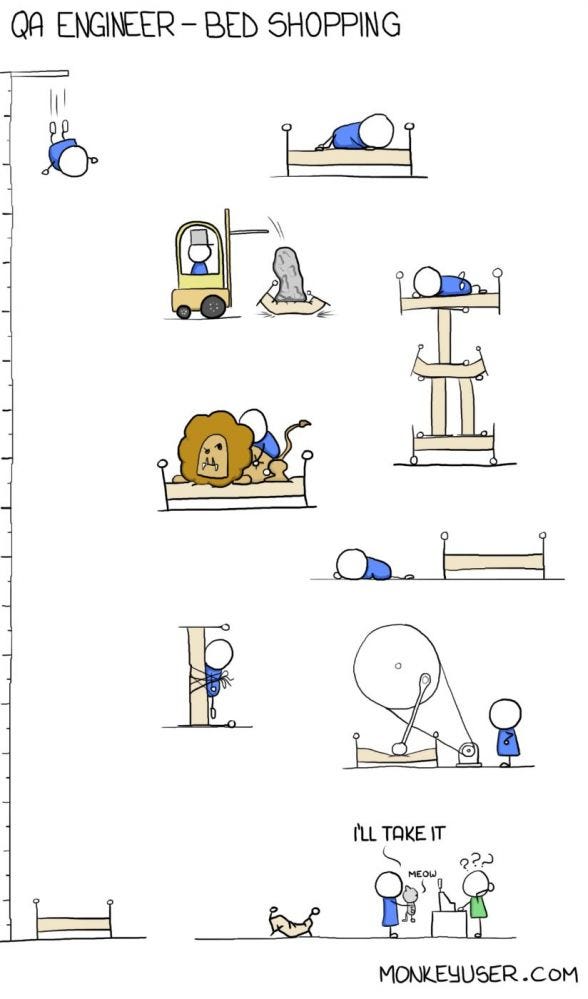 Rumor has it this is how a QA buys a bed.
Is the QA Alone Responsible for Quality?
No. Quality is the team’s responsibility. Everyone needs to be aware that their specific role impacts the final product. The QA professional provides support, bringing practices, analysis, and insights to lead this process.
In an agile team, for example, they can:
- Support the PO in understanding requirements and writing stories.
- Help the UX designer with layout approvals.
- Create automated or manual test scenarios.
- Assist DevOps in integrating automated tests into the CI/CD flow.
Is the Job Done Once the Product is Finished?

Nope. After delivery, the end-user takes over. New feedback and unmapped bugs might surface, which is where the quality cycle begins all over again.
Post migrated from Medium
- By Mai R. on May 14, 2021.
- Original link